
 630-409-8184
How is the Duration of Alimony Determined in Illinois?
 Divorce affects millions of families each year. According to the Centers for Disease Control and Prevention, there were over 600,000 divorces in the United States in recent years. For couples with income differences, spousal support (commonly called alimony) helps the lower-earning spouse maintain financial stability after divorce.
If you are going through a divorce in Illinois in 2026, understanding how long alimony payments may last is important for planning your financial future. A Geneva, IL divorce attorney can help you understand what to expect.
Can We Decide on Alimony for Ourselves?
Yes, absolutely. Illinois courts prefer to see couples figure out issues in their divorce on their own, or with the help of mediators, whenever possible. If you and your spouse can reach an agreement that feels fair to both of you, the court will likely enforce it.
If you would prefer not to leave the issue of alimony to a judge to decide, but you can’t agree on your own, you may want to work with a mediator. You may also want to consider negotiating with other pieces of your marital estate. For example, perhaps you want to stay in your family home with kids under age 18. You may want to trade equity in the home, or a lump-sum alimony payment that allows you to refinance your mortgage, for long-term alimony payments.
Couples who negotiate alimony and other divorce issues themselves are more likely to come up with creative solutions that work long-term. If you cannot, a judge will decide for you based on the facts available. This may result in a solution neither of you is satisfied with.
Illinois Alimony Law
Illinois uses a formula to calculate how long alimony lasts based on the length of your marriage. This formula appears in Section 504 of the Illinois Marriage and Dissolution of Marriage Act. The law provides guidelines, but judges still consider your unique situation when making final decisions.
For marriages that lasted less than five years, alimony payments typically continue for 20 percent of the time you were married. For example, if you were married for four years, alimony would last about 0.8 years or roughly 10 months.
For marriages between five and 20 years, the percentage increases as the marriage length increases. A marriage lasting five to six years results in alimony payments that last 24 percent of the time you were married.
The percentage keeps increasing for longer marriages up to 20 years. For long-term marriages of 20 years or more, alimony may continue for either the entire length of the marriage or an indefinite period. This means if you were married for 25 years, alimony could last 25 years but it might also be indefinite.
The formula serves as a starting point. Illinois judges can adjust the alimony duration based on the specific details of each divorce case. The law does not require judges to follow the formula exactly in every situation.
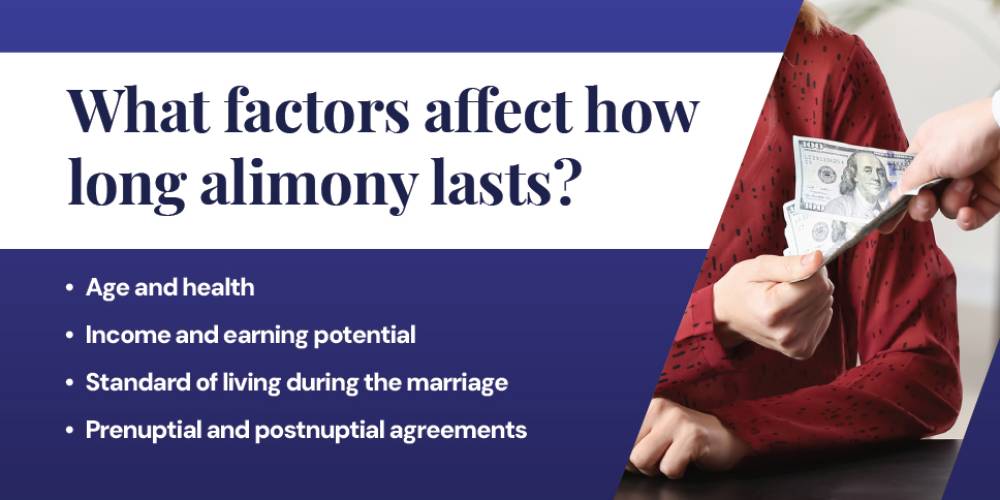
What Factors Can Affect How Long Alimony Lasts?
Besides marriage length, Illinois courts look at several other factors when deciding how long alimony should last. These factors allow judges to customize alimony to fit the needs and realities of each couple.
Age and Health Considerations
The age and health of both spouses matter a lot. If one spouse is much older or has health problems that impact their ability to earn money, the judge may order them to receive alimony payments longer. Age and health issues tend to play a larger role in long-term marriages where one spouse may have spent many years not working.
Income and Earning Potential
The income levels and future earning capacities of both people are also considered. If one spouse earns significantly more, alimony may be lengthened to make up for the difference and allow the lower-earning spouse time to become self-supporting. However, alimony duration may be shortened if both spouses have similar earning potential or if the receiving spouse can quickly become financially independent.
Standard of Living During Marriage
Judges also examine the standard of living established during the marriage. If the couple enjoyed a comfortable or luxurious lifestyle, alimony might be extended to allow the receiving spouse to maintain a similar standard, especially after a long marriage. For modest lifestyles, support payments will not typically last as long.
Other Important Factors
Additional considerations include:
-
The contribution of each spouse to the marriage, including homemaking and childcare
-
The time the receiving spouse needs to acquire education or training for employment
-
Any prenuptial or postnuptial agreements
-
The tax consequences of alimony payments
Each divorce is different, so judges weigh these factors carefully when determining how long alimony should continue.
Can Alimony Duration Be Changed After a Divorce?
Sometimes alimony duration can be changed after the initial court order. Life circumstances change, and Illinois law recognizes this reality. If the paying spouse experiences a significant change in income or employment status, they can request an early termination or reduction of alimony.
This requires filing a motion with the court and providing evidence to justify the change. Examples include job loss, serious illness, or retirement. Similarly, if the receiving spouse's financial situation significantly improves, the paying spouse can request a modification based on the changed circumstances. This might happen if the receiving spouse gets a high-paying job, remarries, or receives a substantial inheritance.
It is important to note that securing an alimony adjustment requires clear proof and court approval. You cannot simply stop making payments because you think your circumstances have changed enough. You must go through the proper legal process.
Alimony also automatically terminates if the receiving spouse remarries or if either spouse dies. Some alimony orders may also end if the receiving spouse lives with a romantic partner.
Call a Kane County, IL Alimony Attorney Today
Understanding how long alimony lasts helps you plan for your financial future during and after divorce. The calculations can be complex, and many factors influence the final outcome.
A Geneva divorce lawyer can review your specific situation and help you understand what to expect. Contact The Law Office of Matthew M. Williams, P.C. at 630-409-8184 today to discuss your case and learn about your options.






Ready to Get Started?
To schedule a free consultation with Aurora divorce attorney, Matthew M. Williams, call 630-409-8184 or fill out the form below.



Aurora
1444 North Farnsworth Ave., #307
Aurora, IL 60505
P 630-409-8184
MAP + DIRECTIONS
BY APPOINTMENT ONLY
Yorkville
520 E Kendall Drive, Suite C-1
Yorkville, IL 60560
P 630-409-8184
MAP + DIRECTIONS


